

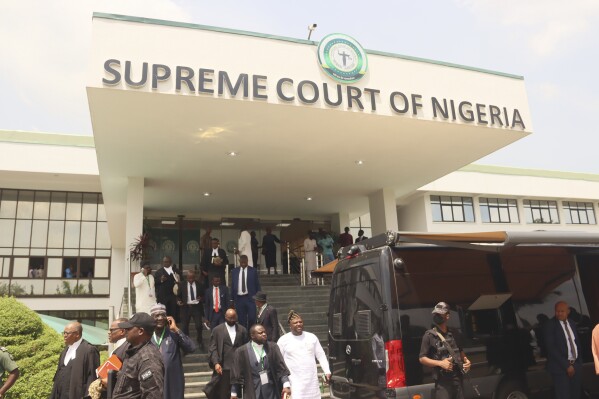
The Senate on Thursday sealed a critical chapter in Nigeria’s judicial succession as they Screen President Bola Ahmed Tinubu’s nominee, Hon. Justice Oyewole Joseph Olubunmi Kayode, as a Justice of the Supreme Court of Nigeria, following what lawmakers described as a thorough, transparent and constitutionally grounded screening process.
The Screening came after President Tinubu formally transmitted the nomination to the Red Chamber, seeking legislative approval in line with the provisions of the 1999 Constitution (as amended).
Proceedings at the Senate were conducted strictly within constitutional boundaries, with the Judiciary, Human Rights and Legal Matters Committee leading the screening exercise that examined the nominee’s professional record, judicial temperament and integrity.
Speaking with journalists shortly after the confirmation, Chairman of the Senate Committee on Judiciary, Human Rights and Legal Matters, Senator Niyi Adegbonmire, dismissed claims of secrecy or rubber-stamping, insisting that the exercise met the highest standards of legislative scrutiny.
“The screening was thorough and transparent,” Adegbonmire said.
“Justice Oyewole’s curriculum vitae was circulated to all Senators ahead of time, allowing members to independently review his qualifications, career progression and judicial experience.
During the session, Senators asked substantive questions, all of which the nominee answered convincingly, demonstrating competence, depth and readiness for the Supreme Court.”
He explained that the smooth nature of the exercise should not be misinterpreted as political alignment with the executive arm of government, stressing that Supreme Court appointments follow a rigid constitutional process that limits arbitrariness.
According to him, the journey to the apex court begins long before the President’s nomination, with a painstaking evaluation by the National Judicial Council (NJC).
“The NJC subjects prospective Justices to rigorous assessment based on years on the bench, judicial conduct, performance, experience and professional integrity,” he noted. “Only candidates who pass this demanding process are recommended to the President, alongside detailed reports and scoring.
These same reports are made available to the Senate to guide our confirmation process.”
Adegbonmire emphasized that the Senate’s constitutional role is not to oppose the executive reflexively, but to act in the national interest where nominees meet all legal and constitutional requirements.
“Democracy does not mean automatic confrontation,” he said. “Where there is no breach of law and the nominee satisfies all criteria, it is the duty of the Senate to confirm such nominations in the interest of the nation.”
Addressing broader concerns about judicial outcomes, the lawmaker cautioned against judging the judiciary solely through the lens of controversial court decisions.
He noted that litigation naturally produces winners and losers, warning that dissatisfaction with judgments should not translate into wholesale condemnation of the judicial system.
“Allegations of injustice must be weighed against facts, evidence and due process, not sentiment or speculation,” he said, adding that while human errors may occur, they remain exceptions rather than the norm.
Senator Adegbonmire reaffirmed the Senate’s commitment to protecting judicial independence, strengthening the rule of law and upholding constitutional governance.
With the confirmation of Justice Oyewole, the Senate has once again asserted its role in shaping the nation’s judicial architecture, reinforcing public confidence in the integrity of appointments to Nigeria’s highest court.